Embracing my inner-hick
Back in school I had long considered myself smart, sophisticated, and cool, at least enough. I studied broadly. I read. I wrote. I engaged in discussions. I earned good grades and impressive test scores. It was in the summer between my junior and senior years in college when I learned that smart, sophisticated, and cool are relative, and, relatively speaking, I was a hick.
While studying journalism at Ohio University, I was chosen for the Magazine Publishers Association’s summer internship program. The MPA selected fifty or so college kids from across the country, brought us to New York City to be editorial interns, and assigned us to work at various Manhattan-officed magazines, ranging from Time to Cosmopolitan to Progressive Grocer.
To house us, the Magazine Publishers Association rented out a floor in a New York University dorm in Greenwich Village and randomly assigned rooms and roommates. I got a guy named Neal Karlen from Brown University. We became friends quickly and all summer. Yet it was through our relationship that I first came to realize how dumb and rube I was.
The fifty of us, for the most part, we cliqued. One clique comprised the Ivy Leaguers. Besides Neal there were several from Yale, Harvard, Princeton, wherever.
Neal became the Ivys Cool Dog, and so they hung out in our room. Consequently, I became an unofficial member. Soon though, after a few late-night, alcohol-lubricated bull sessions, I was feeling more like Neal’s kid brother. Knowingly or not, for sport or through unintentional inevitability, they destroyed me, frequently making me feel so much the lesser. Roaming from politics to pop culture, these bull sessions covered a lot of ground foreign to me as a Midwestern-small-city-public-schools-state-college kid. I couldn’t keep up. I often had no idea what they were talking about. These Ivy kids all struck me as way smarter, way better-educated, way more-experienced, way more-honed, way savvier. Way better. On too many occasions, I said something anyway, something stupid, reminding everyone of my hickness. I still have memories that make me wince.
Don’t worry about me though. This post isn’t about my regrets or bad memories. I’m just using myself as an example. This post is about what I learned, how key lessons affect my writing, and how useful I think they ought to be to all writers.
Regardless of causes, just or unjust, class distinctions are real. They can distort someone’s self image, they can cause painful soul-searching, and all kinds of silly little problems that could be useful to character development, dialogue, and plot. As an author, I find myself nearly always conscious of class when I’m fleshing out a character, or sending him into narrative or dialogue. I hope it’s a hallmark of my writing.
These class distinctions reveal themselves in details.
For example, and back to me, when I first met Neal and the other Ivys, I was 21—yet I had never even eaten Chinese food, not before they took me along to Chinatown for dinner.
I’ve since realized that class distinctions aren’t so easy to transcend. There can be a great inertia against class advancement.
Again, me. Now I am 67, and I’ve not changed nearly as much as you might expect. There remain uncounted regional cuisines I’ve not tasted, and Lord, I wouldn’t know what to expect or do if I ever dined in a Michelin-starred restaurant. I still don’t know a $10 bottle of wine from a $100 wine. I remain less than conversational about poetry, classical music, jazz, contemporary art, fashion—and this list can go on and on but I’m stopping here. For me, the class distinction differences remain as they’ve ever been.
I’m okay with all of that. Not proud, but accepting.
Here’s the rub though: in my hickness, I’m pretty sure I’m normal, or at least not unusual enough to be considered abnormal.
A very significant percentage of people, certainly most people within my social circles, would say, “Nope, me neither,” to most of the shortcomings I listed above. At the same time, I’m more fortunate than countless others, because of all the things I that have experienced, that I do enjoy. Hell, I’ve met people who told me they had never left the rural county they were born in.
As I write my fiction, I find these social strata differences seem important to me. Most of my characters tend to be like me, which is to say leaning more toward the hick end of the spectrum than toward the Ivy. It’s not as if I write gothic stories filled with Faulknerian characters. But there’s a large stratum of Chinese-is-about-as-exotic-as-food-gets people which I think gets ignored in much fiction. I find most contemporary authors I read tend to place their characters more toward the Ivy end. No judgment from me here, except to say those characters likely reflects the authors’ own stratum, just as mine do mine.
Write what you know, right?
It’s important to remain conscious of what characters would or wouldn’t be familiar with or comfortable with. There’s such rich opportunity for internal conflict as characters encounter even tiny circumstances that challenge those positions. Emotions associated with not belonging, of being an imposter, of being clueless, of being exposed, are confusing and stressful, and can be both humorous and painful, just like that first time I stared at a plate of whatever it was I ordered in that Chinese restaurant, not having any idea what I was looking at. I was ridiculous. I was terrified. I was probably hilarious.
I’m not calling for stories to be based on this. Cinderella’s been done to death. But these details could and should help complicate characters involved in other plots.
Don’t underestimate or neglect the details.
I see too many authors struggle with this. All the time. It’s tough.
Allow me to provide an example:
I’m currently reading Horse, a wonderful and well-reviewed 2022 novel by the incredible author and journalist Geraldine Brooks. She made me cringe at one point, though, where she has one of her characters describe herself as being a bogan (Australian for hick)—right after she prepares puttanesca and approves a wine selection. Oh, good Lord, Geraldine, you have no idea how to be hick, I thought.
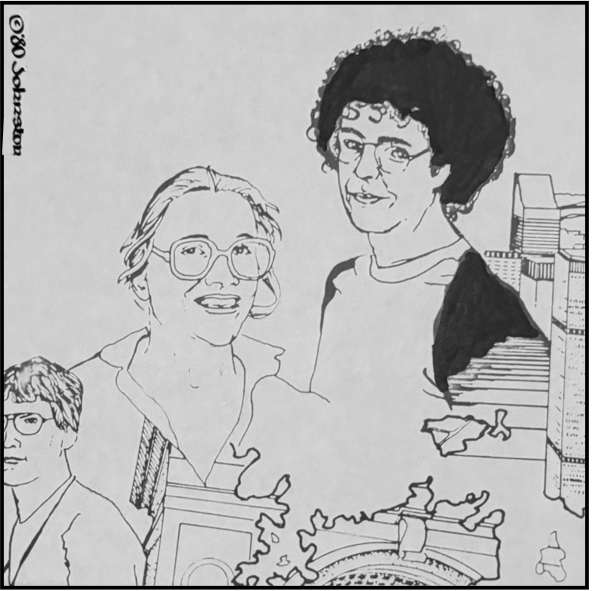
(The art accompanying this blog post is a detail from a drawing of 1980 MPA interns done by Jeff Johnston, a fellow intern, from Princeton, if I recall correctly. He gave copies of his drawing to me and several others at the end of the summer. I still cherish it and thought it would be good for this post. Yet I didn’t bother to track him down to ask his permission to use it here, so I’m pretending he’d be more than happy to let me use it, and I’m thanking him for being so gracious. Thanks, Jeff.)
