AI is dangerous, but at least it’s inept
Are we really following AI into this rabbit hole? Following it knowing, A) The hole is dangerous; and B) AI is demonstrably stupid?
A new economic report out of Stanford University reported:
“Private investment in generative AI (the kind that creates intellectual content) reached $33.9 billion in 2024, up 18.7% from 2023 and over 8.5 times higher than 2022 levels.” The 2025 investment in generative AI is dwarfing that of 2024.
Recently, Jim VandeHei and Mike Allen at Axios wrote:
“AI and its blood and oxygen—chips, data, energy—are producing an economic super-stimulant strong enough to prop up the entire country.”
Also recently, Eduardo Porter of The Guardian wrote:
“The world economy hinges on the success or failure of artificial intelligence. It’s becoming apparent that we are probably doomed either way.”
Then there is this, from Rogé Karma at The Atlantic:
“Evidence is piling up that AI is failing to deliver in the real world. The tech giants pouring the most money into AI are nowhere close to recouping their investments. Research suggests that the companies trying to incorporate AI have seen virtually no impact on their bottom line. And economists looking for evidence of AI-replaced job displacement have mostly come up empty.”
The statement from Karma, about AI failing to deliver, caught my attention after what happened to me earlier this week.
With my latest short story newly published online Thursday, I Googled the title to see if and how the published story is showing up in Google.
Google responded with this “AI Overview,” a generative AI speculation about my story:
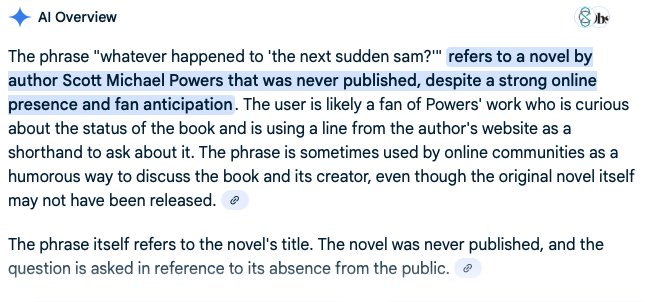
It is wrong. It is total fiction about my fiction.
It reminded me of a bit from the TV show, “Who’s Line Is It Anyway?” Presenter Aisha Tyler reads the prompt: “Whatever happened to ‘The Next Sudden Sam?’” Then Wayne Brady, Colin Mochrie, and Ryan Stiles take turns riffing totally false answers through pure improv. Hilarious.
Except Google offers its AI Overview not as humor, but as an authoritative answer, as fact.
It would be funny, except for, you know, AI is no Wayne Brady. Never will be. Also, there’s Porter writing, “The world economy hinges on the success or failure of artificial intelligence. It’s becoming apparent that we are probably doomed either way.” Not funny.
There is no accountability. Or shame. Apparently, there is no gatekeeper against being completely wrong.
It’s not just Google’s response to my search. There is plenty of evidence right in front of us every day that AI is not only failing to deliver in the real world, but that AI is—at least at this point in its development—unacceptably incompetent. Those AI-generated ads that appear on our social media feeds? Somebody is paying money to place those. How many are so far off that the advertisers might as well smoke their money? Right now, as usual, my Facebook feed is full of sponsored posts ads that do not match me.
How about you?
We’re betting the world economy on a technology that is so inept, that if it were an employee, it would be fired. Tech companies are literally training AI through on-the-job training, promising us it’ll catch on. Eventually. Except, so far, it’s not. It’s easily fooled. And when it doesn’t have enough data, it makes wild guesses. Who does that and survives?
Which brings us to writers and other creatives, and our fear that AI is stealing from us in order to replace us.
Replace us? Call me a naive optimist, but I don’t feel threatened. The techies behind AI are brilliant, but many of them are narrow in their brilliance, raised on STEM, yet adverse to, even hostile to, the humanities. Math, science and engineering, they know. Philosophy, psychology, and sociology, not so much. Their machines would be clueless about matters of the heart and soul, about truth, art, beauty, humor, fear, anger, passion, hopes, desires, wonder, mercy, grace, or real love.
Steal from us? Yes, that is undeniable. Some of us, me included, are awaiting our settlement checks in the Bartz et. al. vs. Anthropic case, over theft of our works. Just about everything else AI offers is also stolen. When I Googled “AI and economy” for the top of this post? I got an AI Overview that included facts and figures that were NOT directly attributed to the human economists and journalists who worked hard to create them.
Businesses don’t care. Investors don’t care. I don’t mean that as an insult. I mean that as a principle of business. Sans legislation—and it ain’t coming—the only negative feedback to AI theft of intellectual properties is litigation. We won $1.5 billion in the Anthropic case. We’ll win more here and there. But really, that’s nickels and dimes in the AI sector. Hardly a disincentive.
What business people do care about is succeeding. If something doesn’t work, they must give it up. Already, advertisers and marketers are paying big for AI. I bet they don’t like it so far. Are bad business decisions being made based on bad information generated by AI, like the AI Overview on my story? Anyone making decisions based on information from a source that has no accountability, no shame, and no gatekeeper is fated to bad decisions.
Eventually, it’ll be time to call stupid “stupid.”
Artificial intelligence is stupid.
